


egro and Pure Data Centres have submitted a pre-planning application for a 60,000 sqm, 56MW IT load facility, representing a £1 billion investment for London. This marks one of the largest single-site proposals in the capital’s recent development pipeline.
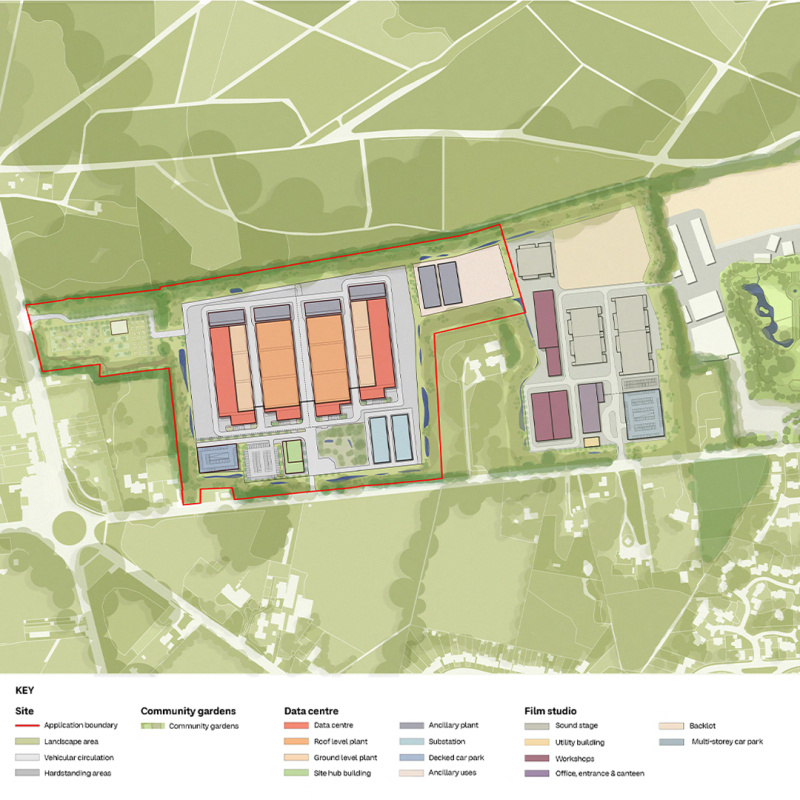
In Iver, Buckinghamshire, Greystoke Land recently received outline planning approval for the West London Technology Centre, a 72,000 sqm data centre development (Glenigan Project). Nearby, Pinewood Studios has submitted an outline planning application for the Pinewood South Data Centre, repurposing a site originally intended for film studio use into a 55,000 sqm digital facility.
Scotland is also emerging as a key player in the data centre development sector. At the former Ravenscraig Steelworks site, developer Apatura has submitted a pre-planning application for a 94,000 sqm data centre valued at £3.9 billion. This proposed scheme is one of the largest in the UK and marks a significant regeneration opportunity for the region.
Other regions are also showing notable activity. In Essex, Caineal LLP has submitted a pre-application for the Wickford AI Data Centre, a 37,000 sqm, £500 million project. In Wiltshire, Ark Data Centres is awaiting detailed planning permission for a 27,000 sqm extension to their existing Spring Park facility in Corsham.
Meanwhile, in Bootle, Merseyside, developer L51 Developments Ltd has entered the pre-application phase for a 45,000 sqm data centre with a proposed 28MW load broadening the geographic spread of high-value projects.
The wave of proposed and progressing data centre projects underscores the sector’s growing role in the UK construction landscape. With major projects distributed across multiple regions, the market offers increasing opportunities for main contractors, specialist suppliers, and infrastructure consultants, say market analysts.
The scale and complexity of these schemes also present prospects for long-term employment and skills development in construction and digital engineering. The diversity in site locations, from urban hubs to post-industrial brownfield land, highlights a maturing market that is both expanding and strategically aligning with national digital ambitions.
As the UK continues to invest in its digital infrastructure, Glenigan data suggests that data centres will remain a key growth driver for the construction industry. With multiple projects advancing through the planning pipeline, and demand from AI and cloud services growing steadily, the outlook for the sector remains robust.
Construction professionals and supply chain partners should expect continued opportunity in this high-growth segment, as the UK positions itself to meet rising data capacity needs with world-class infrastructure.
More from
Data Centres



